











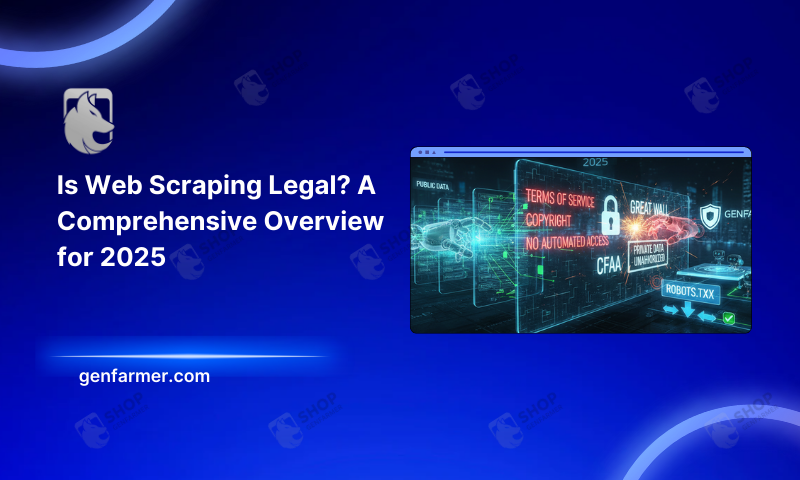
Is Web Scraping Legal? A Comprehensive Overview for 2025

If you work in digital marketing, MMO (Make Money Online), or business intelligence, web scraping is the engine behind your operations. It powers everything from price comparison tools to massive lead generation lists.
But as powerful as it is, one massive question always hangs in the air: Is web scraping actually legal? The short answer is: it’s a gray area. The legality of scraping depends heavily on what you scrape and how you do it. Here is a deep dive into the legal landscape of web scraping in 2026, helping you leverage data extraction without crossing into dangerous legal territory.
What Exactly Is Web Scraping?

Simply put, web scraping (or data extraction) is the automated process of using bots to collect data from websites. Instead of manually copying and pasting information, a scraper visits a page, grabs the targeted data, and organizes it into a structured format like a CSV file.
The legal friction starts here: while a human browsing a public site is totally fine, deploying automated bots at scale puts massive strain on a website’s servers and raises serious questions about data ownership.
The Core Rule: Public vs. Private Data
If you only remember one thing, make it this: the accessibility of the data dictates its legality.
-
Public Data: If anyone on the internet can see the information without logging in or bypassing an authentication wall, scraping it is generally considered legal.
-
Private Data: The second your scraper has to bypass a login screen, enter a password, or break through an authentication barrier, you are crossing into illegal hacking territory.
Key Legal Frameworks You Need to Know

Judges and courts, rather than politicians, have mostly shaped scraping laws. Here are the main frameworks that dictate what you can and cannot do:
1. The Computer Fraud and Abuse Act (CFAA) Historically used to prosecute hackers, companies tried to use the CFAA to stop scrapers, claiming it was “unauthorized access.” However, the landmark LinkedIn v. hiQ Labs (2019) case changed everything. The court ruled that scraping publicly available data does not violate the CFAA. Simply viewing public data is not hacking.
2. Copyright Law & DMCA You cannot copyright facts (like a product’s price or a company’s name). However, if you scrape and republish creative content (like blog posts, photos, or videos), you are committing copyright infringement. Furthermore, the DMCA makes it illegal to bypass anti-scraping technologies like CAPTCHAs.
3. Terms of Service (ToS) Most websites state “no automated bots” in their Terms of Service. While ignoring a ToS isn’t a federal crime (thanks to the LinkedIn ruling), it is a breach of contract. A company can still hit you with a civil lawsuit if they prove your scraping damaged their servers.
Best Practices for Safe Web Scraping in 2026
To protect your operations and avoid cease-and-desist letters, strictly follow these rules:
-
Check robots.txt: Always read the target site’s
robots.txtfile. If it explicitly disallows bots in certain directories, stay out. -
Throttle Your Requests: Do not hammer a server with a thousand requests per second. Slow down your bots to mimic human behavior so you don’t crash their site.
-
Avoid PII (Personal Data): Stay away from scraping Personally Identifiable Information (emails, phone numbers). Laws like GDPR (Europe) and CCPA (California) will heavily penalize you for mishandling this data.
-
Never Bypass Logins: As stated, if it requires an account to view, do not scrape it.
Scaling Safely with Hardware Solutions
For MMO professionals, relying entirely on software to scrape or automate accounts is a quick way to get your IPs flagged and banned. True scalability requires hardware-level defense.
This is where the GenFarmer ecosystem steps in. By utilizing our Box Phone Farm infrastructure paired with a Router Proxy, you can manage hundreds of unique, clean IPs at the network level. Whether you are running automation tools like GenFarmer Trust or gathering market intelligence, our hardware ensures your operations remain undetectable, efficient, and secure.
Stop risking your main network. Upgrade your infrastructure and scale your data operations safely.
Frequently Asked Questions (FAQs)
Is it illegal to scrape a website if its Terms of Service forbid it? It is not a criminal offense (like hacking), but it is a breach of contract. The website owner can block your IP or potentially file a civil lawsuit against you for damages.
Can I scrape email addresses for my marketing campaigns? This is extremely risky. Scraping personal data like emails often violates strict privacy laws such as the GDPR or CAN-SPAM Act, leading to massive fines.
How do I prevent my scraper from getting IP banned? To avoid IP bans, you must route your requests through rotating residential or 4G proxies, respect rate limits, and use high-quality hardware like a Router Proxy to manage your network fingerprint.






 VOUCHER
 DEMO 1-1