

Differences Between Anaerobic Pyrolysis Biochar Rice Husk and Traditional Hand-Burned Rice Husk – What is the Optimal Choice?
In recent years, the demand for using biochar rice husk in agriculture, plant cultivation, growing media production, and industrial applications has been increasing rapidly. However, two common product lines currently exist on the market: anaerobic pyrolysis biochar rice husk and traditional hand-burned rice husk. Many people often mistake the two for the same product, but in reality, they differ significantly in production technology, carbon content, quality, and usage efficiency.
The article below will help you clearly understand the differences between anaerobic pyrolysis biochar rice husk and traditional hand-burned rice husk to choose the product that best suits your needs.
What is Anaerobic Pyrolysis Biochar Rice Husk?
Anaerobic pyrolysis biochar rice husk is produced using pyrolysis technology in a limited-oxygen or nearly oxygen-free environment. Rice husks are heated at high temperatures, usually ranging from 400 – 700°C, which converts most of the organic matter into stable carbon.
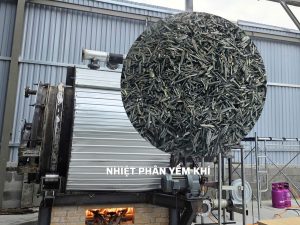
The resulting biochar product features:
- High fixed carbon content.
- Uniform black color.
- Intact-hull structure or stable granular form.
- High purity with minimal ash and impurities.
- Superior water, nutrient, and microbial retention capabilities.
This technology is widely applied in modern biochar production plants worldwide.
What is Traditional Hand-Burned Rice Husk?
Traditional hand-burned rice husk is produced by burning rice husks directly in the open air or in simple manual kilns. The burning process relies heavily on the operator’s experience and environmental conditions.
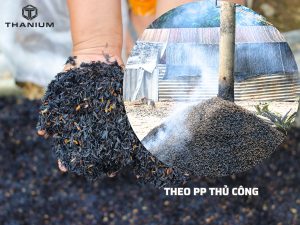
Because temperature and oxygen levels cannot be controlled, the product often exhibits:
- Over-burned parts turned into ash.
- Incompletely carbonized parts.
- Inconsistent quality between production batches.
- Lower carbon content compared to pyrolysis biochar.
This method has low investment costs but struggles to meet high-quality requirements.
Comparison Between Anaerobic Pyrolysis Biochar Rice Husk and Traditional Hand-Burned Rice Husk
1. Production Technology
Anaerobic pyrolysis biochar rice husk
- Uses modern pyrolysis kilns.
- Precisely controls temperature.
- Restricts oxygen during the carbonization process.
- Produces uniform products.
Traditional hand-burned rice husk
- Burns directly via traditional methods.
- Difficult to control temperature.
- High oxygen contact with raw materials.
- Quality depends on the maker’s experience.
2. Carbon Content
Anaerobic pyrolysis biochar generally achieves a much higher and more stable carbon content than traditional hand-burned rice husk.
This helps to:
- Increase soil improvement efficiency.
- Enhance nutrient adsorption capacity.
- Raise the utility value in industrial and metallurgical applications.
3. Product Uniformity
Pyrolysis biochar rice husk has a uniform black color, a high carbonization rate, and very few half-burnt grains.
Meanwhile, traditional hand-burned rice husk often contains:
- Unburnt yellow rice grains.
- White ash due to over-burning.
- Impurities from the production environment.
4. Water and Nutrient Retention Capacity
One of the standout advantages of anaerobic pyrolysis biochar is its highly developed pore structure.
Thanks to this, the product has the ability to:
- Retain water better.
- Hold fertilizers more effectively.
- Boost the activity of beneficial microorganisms in the soil.
- Limit nutrient leaching.
This is why biochar is increasingly applied in organic and high-tech agriculture.
5. Ash Content
Due to the well-controlled pyrolysis process, anaerobic biochar has a significantly lower ash proportion than the hand-burned product.
A low ash content helps to:
- Increase the ratio of useful carbon.
- Elevate economic value.
- Ensure stable quality for industrial applications.
Why Modern Agriculture Prioritizes Anaerobic Pyrolysis Biochar?
Agricultural farms and enterprises currently prioritize anaerobic pyrolysis biochar due to its long-term benefits:
- Improves soil structure.
- Enhances fertilizer utilization efficiency.
- Reduces irrigation water costs.
- Increases the density of beneficial microorganisms.
- Supports sustainable cultivation.
- Contributes to carbon sequestration and greenhouse gas emission reduction.
Particularly for professional vegetable, fruit tree, orchid, ornamental plant growing models, and growing media production, pyrolysis biochar delivers superior efficiency compared to traditional burned rice husks.
Although both are produced from rice husks, anaerobic pyrolysis biochar rice husk and traditional hand-burned rice husk differ greatly in production technology, quality, and usage effectiveness. If you need a stable product with high carbon content, low ash, and excellent water and nutrient retention capabilities, anaerobic pyrolysis biochar is the optimal choice.
Amidst the current trend of sustainable agriculture and circular economy, anaerobic pyrolysis biochar is gradually becoming the preferred solution for both agricultural and industrial sectors.
Contact THANIUM right away for consultation on pyrolysis technology and carbon-rich, intact-hull biochar soil-improving finished products!